

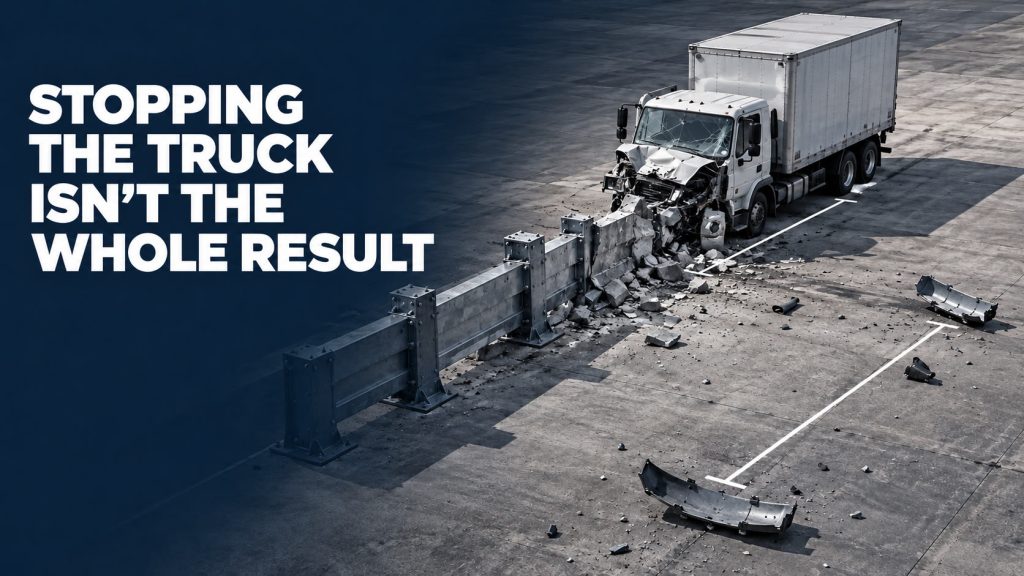
A barrier can stop the vehicle and still leave an unacceptable result on the protected side. HVM penetration distance shows how far the vehicle reaches beyond the barrier datum, while major debris dispersion shows where significant detached parts finally travel. Both can affect the usable stand-off behind the barrier.
Penetration is more than “stopped”
The final position of the vehicle matters because the protected zone may contain pedestrians, a façade, critical equipment or an access-control point. ISO 22343-1:2023 provides a vehicle-impact test method and performance rating for vehicle security barriers, including measurement of vehicle penetration. ASTM F2656/F2656M-23 likewise establishes penetration performance levels for defined impact conditions.
When teams compare ratings, the stated HVM penetration distance should be read together with the test vehicle, mass, speed, impact angle and tested installation. A short distance from one test configuration cannot automatically be transferred to a different vehicle threat or foundation condition.
Major debris needs its own review
Parts of the vehicle, ballast or barrier can separate during impact and travel farther than the main vehicle body. NPSA guidance highlights how far the vehicle and major debris travel beyond the barrier before stopping as key test outcomes. For crowded venues or assets positioned close behind the barrier line, that distinction can be decisive.
Use the result to improve the system
Engineering analysis can help explain why the vehicle or components travelled as observed. Load paths, local tearing, anchor response, barrier deformation and foundation behaviour can be reviewed together. GloBAS Engineering supports vehicle-impact simulation, structural deformation assessment, material and thickness optimisation, and foundation and anchorage validation.
The practical objective is not to replace formal impact testing. It is to identify design changes that may reduce HVM penetration distance, control failure modes and lower redesign risk before the next physical test.
Explore GloBAS Engineering’s engineering services and NPSA’s official overview of impact testing of vehicle security barriers.
 Dubai

 Dubai
 Munich
 Cairo