

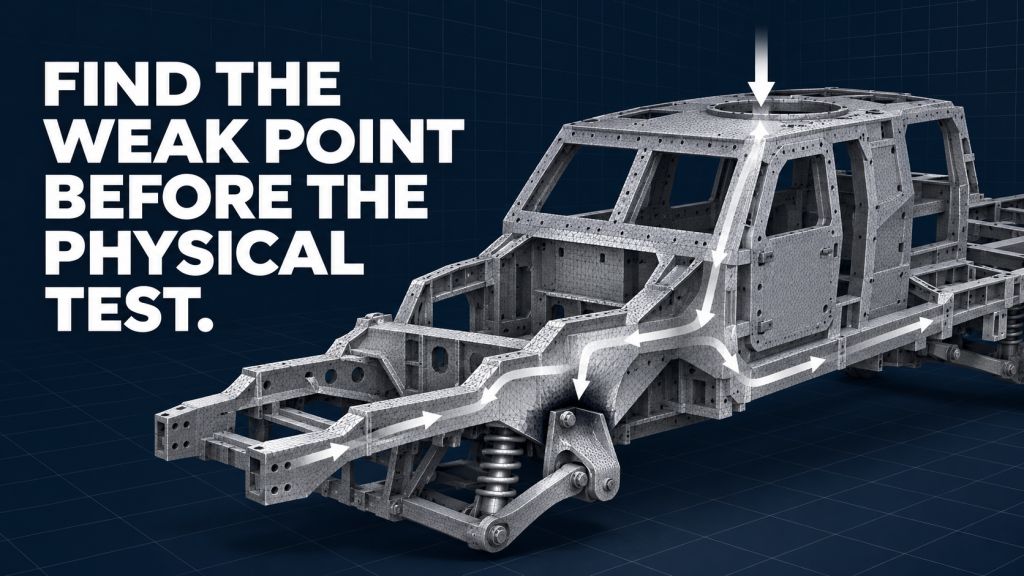
A vehicle structure can appear robust in CAD and still concentrate load at a bracket, weld, mounting point or local change in section. Static stress analysis for specialised vehicles helps engineering teams identify these weaknesses before material is cut and prototype test schedules are committed.
The useful question is not simply, “Where is the highest stress?” It is whether the model represents how forces enter, travel through and leave the structure. Payload reactions, lifting points, seat or equipment mountings, suspension interfaces, door and hatch openings, bolted connections and welded joints can all redirect the load path.
A credible static stress analysis for specialised vehicles reviews displacement, stress, strain, reaction forces, contact behaviour and local stiffness under loads that do not create significant inertia or damping effects. This definition is consistent with the Ansys static structural analysis guidance. Where contact, plasticity, large deformation or preload matters, a nonlinear assessment may be required.
The objective is an actionable engineering assessment: reinforce a bracket, change a weld detail, adjust thickness, improve a joint, redistribute a mounting load or remove mass from genuinely low-demand regions. Sensitivity checks also show whether a hotspot is a real design concern or a modelling artefact caused by idealised constraints or geometry.
Static stress analysis for specialised vehicles does not replace required physical compliance or certification testing. It supports virtual preparation for those tests by improving design maturity and helping teams focus instrumentation and test effort on the most critical areas.
GloBAS Engineering provides structural simulation, static and dynamic assessment, fatigue analysis and design optimisation as an engineering simulation and design-verification partner. See our engineering services, or send us the assembly, available CAD data and key load cases for an initial technical discussion.
 Dubai

 Dubai
 Munich
 Cairo