

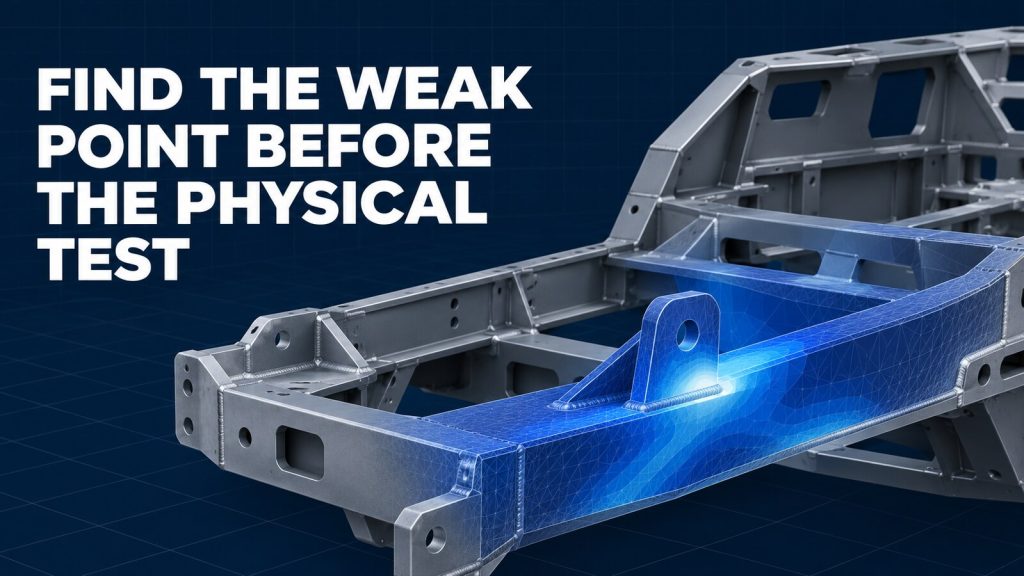
A prototype can look ready and still fail at a bracket, weld, joint or mounting point when the real load arrives. Engineering simulation helps teams expose those weaknesses earlier—before machining, assembly and a costly physical test programme.
The useful result is not a colourful stress plot
A credible structural assessment begins with the actual design question. What load cases matter? How are forces transferred through the assembly? Where do contact, fasteners, welds, material behaviour or boundary conditions change the response?
With engineering simulation, engineers can review stress, deformation, load paths, local concentrations and safety margins under relevant static or dynamic conditions. The model can highlight whether a hotspot is a genuine design risk, a connection problem or a modelling artefact. This supports targeted changes such as adjusting thickness, refining a weld detail, relocating a bracket or improving the load path.
Use virtual testing to improve the physical test
Virtual testing does not replace required physical certification. It helps teams enter that stage with a better-understood design, fewer avoidable weak points and a clearer instrumentation and test plan. This is consistent with the environmental-tailoring approach described in the active MIL-STD-810 document record, where design and test conditions are linked to realistic service environments rather than treated as a universal checklist.
GloBAS Engineering supports manufacturers and R&D teams with structural analysis, static and dynamic assessment, fatigue evaluation and design optimisation. Our engineering simulation services can be applied to frames, protective structures, equipment mountings, welded assemblies, doors, hatches and other load-bearing systems.
Preparing a prototype for IDEX or an upcoming test programme? A focused defence engineering simulation review can show where the design deserves attention first. Contact us to discuss the structure, available CAD data and critical load cases.
 Dubai

 Dubai
 Munich
 Cairo